
CNC Turning vs CNC Milling: Understanding the Right Machining Process
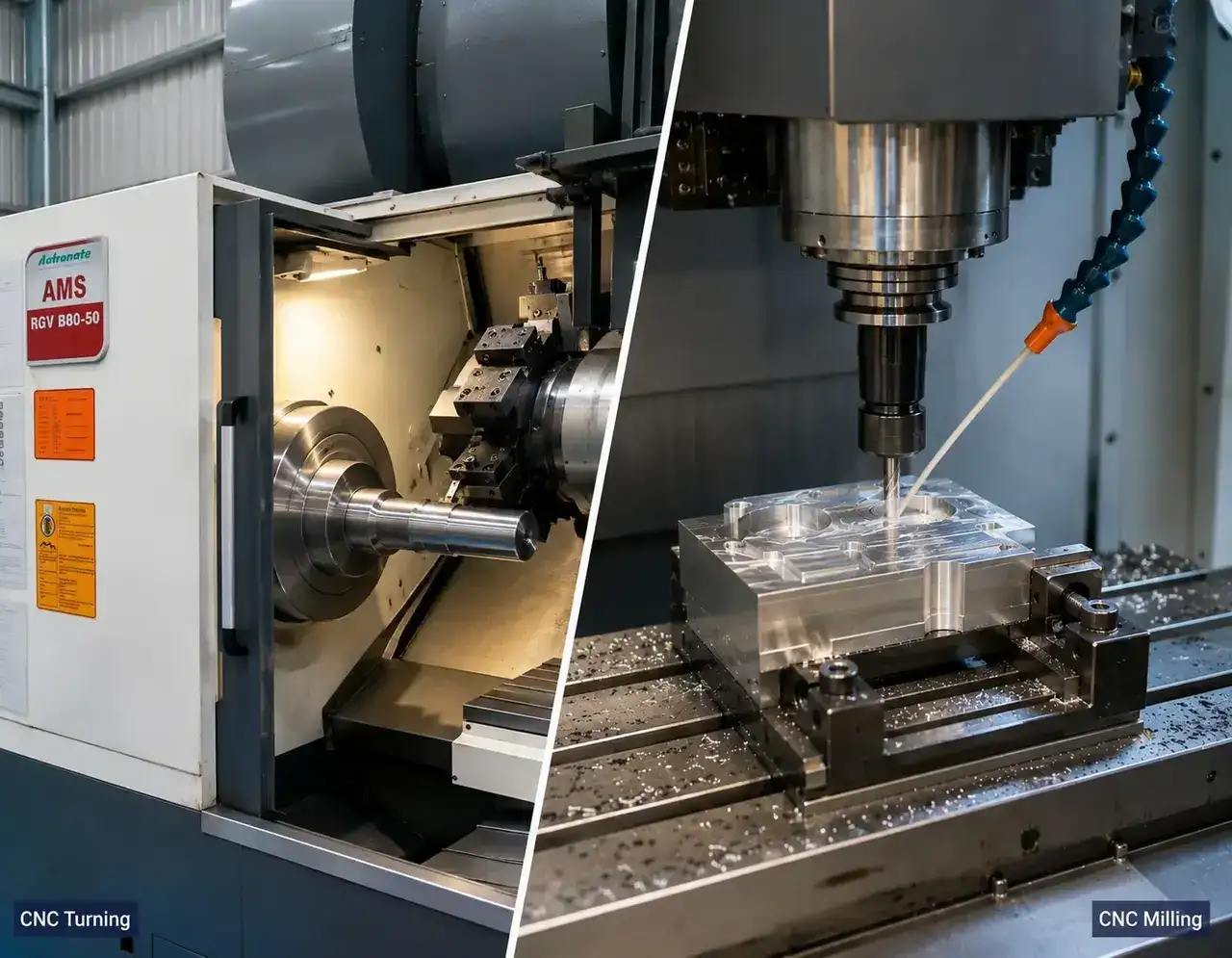
CNC turning and CNC milling are two widely used machining processes for producing accurate metal components. Although both use computer-controlled machines and cutting tools, they remove material in different ways and are suited to different component geometries.
Choosing between the two is not simply a matter of selecting the newer or more capable machine. The correct process depends on the shape of the component, the features required, the material, dimensional requirements and the most efficient way to manufacture the part.
How CNC Turning Works
In CNC turning, the workpiece rotates while a cutting tool moves against it to remove material. This makes turning particularly suitable for components with cylindrical or rotational features.
Typical turning operations can include facing, external diameter machining, internal boring, grooving, threading and other operations required to produce the specified geometry.
Components Suited to CNC Turning
- Components with cylindrical bodies
- Shaft-like geometries
- Threaded rotational parts
- Components with concentric internal or external features
- Parts where diameter control is a major requirement
The process can be highly efficient when the majority of the component geometry is based around a central axis.
How CNC Milling Works
In CNC milling, the cutting tool rotates while the machine controls the movement of the tool and workpiece to remove material from different surfaces. Milling is well suited to components that contain flats, pockets, slots, profiles, holes and other features that are not primarily rotational.
Components Suited to CNC Milling
- Parts with flat surfaces
- Components containing slots or pockets
- Irregular profiles
- Parts requiring multiple machined faces
- Components with positional features that cannot be efficiently produced by turning alone
CNC Turning vs CNC Milling
| Factor | CNC Turning | CNC Milling |
|---|---|---|
| Primary movement | Workpiece rotates | Cutting tool rotates |
| Typical geometry | Cylindrical and rotational | Prismatic, flat and complex profiles |
| Common features | Diameters, threads, grooves and bores | Slots, pockets, flats, profiles and drilled features |
| Best suited for | Axisymmetric components | Components with multiple non-rotational features |
Why Component Geometry Matters
The geometry of a part should drive process selection. If a component is mainly cylindrical, turning can remove material efficiently while maintaining control over diameter-related dimensions. If the component has several flat faces, pockets or complex profiles, milling may provide a more practical manufacturing route.
Some components require both processes. A rotational feature may first be produced by turning, followed by milling to create a flat, slot or other secondary feature. The manufacturing sequence should be planned around the final geometry and the required tolerances.
What About Dimensional Tolerances?
Machining process selection should also consider the tolerances specified on the engineering drawing. Not every dimension necessarily requires the same level of control. Critical dimensions should be identified so that the manufacturing and inspection process can concentrate on the characteristics that affect fit and function.
It is also important to consider the relationship between features. A component may have several dimensions that are individually acceptable but still create an assembly issue if their relative position is incorrect. This is why precision machining involves more than checking individual measurements.
Material Can Influence Process Selection
Different metals behave differently during machining. Cutting characteristics, work-hardening behaviour, heat generation, chip formation and tool wear can influence the choice of tooling and machining parameters.
Brass, copper, aluminium, stainless steel and mild steel can therefore require different process considerations. The material should be evaluated together with the component geometry and required finish rather than treating all metals in the same way.
How to Select the Right CNC Process
- Study the drawing: Identify critical dimensions, tolerances, threads, holes, profiles and surface requirements.
- Review the geometry: Determine whether the part is primarily rotational, prismatic or a combination of both.
- Consider the material: Evaluate machining characteristics and tooling requirements.
- Plan the sequence: Decide how the component can be produced while maintaining the required feature relationships.
- Define inspection points: Identify the dimensions and characteristics that need verification.
When Is a Combination of Turning and Milling Useful?
Combination machining becomes useful when a component contains both rotational and non-rotational features. Instead of forcing one process to perform work for which it is not suited, manufacturers can divide the operations according to the geometry.
This approach can also reduce unnecessary machining and make the production sequence easier to control. The objective is not simply to use more processes; it is to use the appropriate process for each feature.
Process Planning Supports Repeatability
For production work, process planning is important because the same component may need to be manufactured repeatedly. A documented sequence helps maintain consistency in machine setup, tooling, inspection and production requirements.
A structured quality system can support this approach. DIPAK SALES holds ISO 9001:2015 certification for the manufacture of precision metal components.
Frequently Asked Questions
Which is better, CNC turning or CNC milling?
Neither process is universally better. CNC turning is generally more suitable for rotational geometries, while CNC milling is better suited to flat surfaces, pockets, slots and complex non-rotational features.
Can one component require both turning and milling?
Yes. A component can be turned to produce cylindrical features and then milled to create flats, slots, pockets or other secondary features.
Does material affect CNC machining?
Yes. Material properties influence tooling, cutting conditions, chip formation, tool wear and the overall machining approach.
Conclusion
CNC turning and CNC milling solve different machining problems. The best process is determined by the component's geometry, material, tolerances and functional requirements. When these factors are considered together, manufacturers can develop a machining route that balances accuracy, repeatability and production efficiency.


